
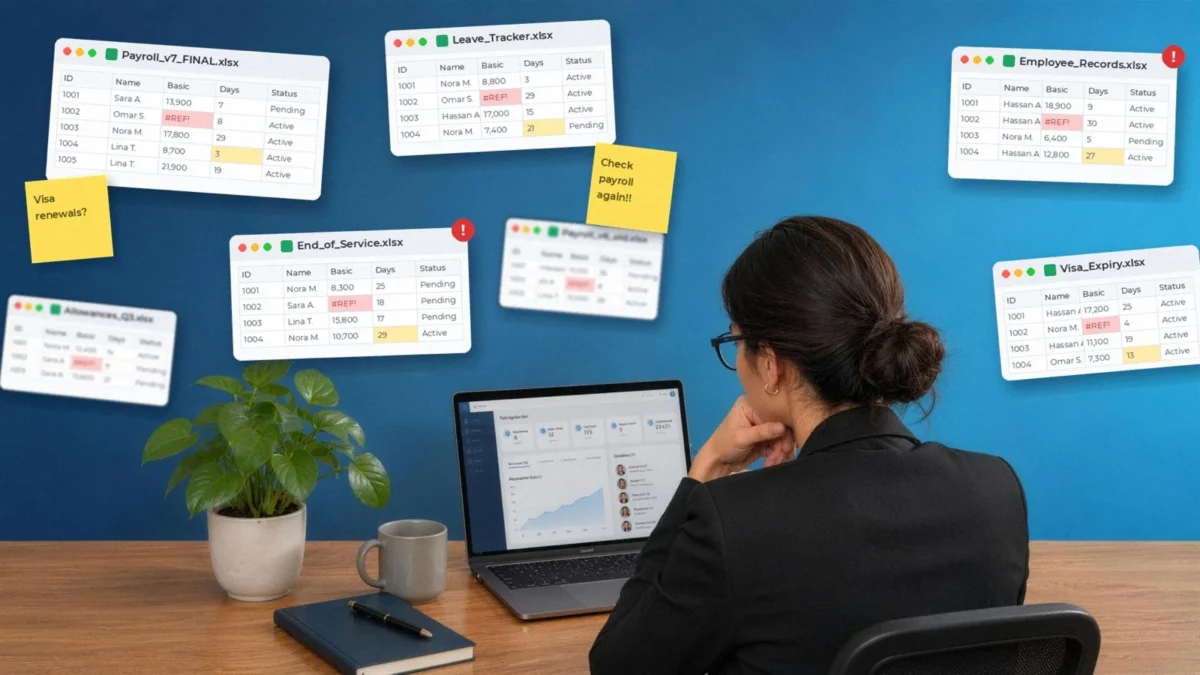
Human resources management is no longer just an administrative function limited to running payroll and keeping employee files. Today it sits at the heart of a company’s ability to grow, compete and retain the best talent. Yet many companies in Saudi Arabia and across the GCC still manage their most important asset, their people, with tools that were never designed for the job: scattered spreadsheets, emails, paper forms and disconnected systems that do not talk to one another.
The question is no longer whether a company needs a smarter HR management system (HRMS), but how much it loses each day it puts off this step.
By Mohamad Habbal, HRMS Implementation Specialist at Synergi
The Challenges of Traditional HR Management
1. Manual errors and their hidden cost When salaries, allowances, leave and end-of-service benefits are calculated manually, or through spreadsheets linked by complex formulas, errors become a matter of time. A payroll error does not stay a number on paper. It directly affects employees’ trust in the company and consumes the HR team’s time in corrections and reviews instead of work that adds real value.
2. Scattered data and multiple versions In many organisations, an employee’s data sits in more than one place: one file with HR, another with Finance and a third with the line manager. With every update, the likelihood of conflicting records grows. The result is that management does not fully trust the figures presented to it, and even the simplest report takes days of compiling and checking.
3. Compliance complexity in a changing regulatory environment Companies in the GCC operate within precise regulatory frameworks that are constantly evolving, from wage protection systems (WPS) to localisation requirements such as Saudization and Emiratisation, to labour laws and their amendments. Tracking these requirements manually, especially for companies operating in more than one country, is a heavy burden and a real risk, as delays or inaccuracies can lead to fines or disruption to government transactions.
4. An HR team buried in administrative work Many HR professionals spend most of their day answering repetitive questions: How much leave do I have left? When will my salary certificate be issued? Has my request been approved? That time could instead go towards attracting and developing talent and building a healthy organisational culture.
5. Decisions without clear visibility Without unified, up-to-date data, it is difficult to answer basic strategic questions: What is the employee turnover rate in each department? Where are workforce costs concentrated? Which teams need support or restructuring? All too often, these decisions are made on instinct rather than evidence.
What Sets a Smart HR System Apart?
A smart system is not simply a digital copy of paper-based procedures. It is an integrated platform that redesigns the way work itself is done. Its key benefits include:
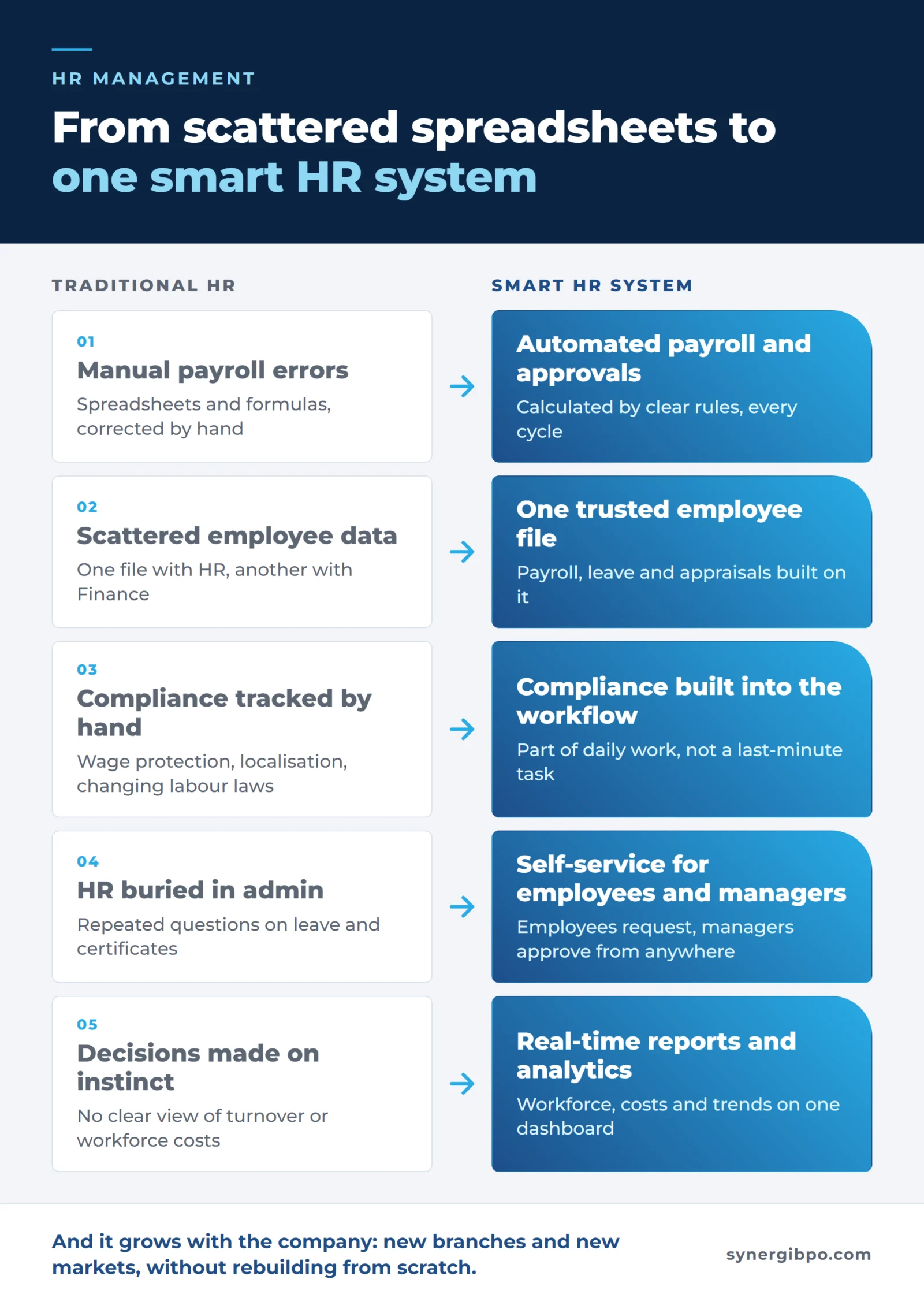
- A single trusted source of data: one unified file for each employee, on which payroll, leave, appraisals and reports are built, so conflicting versions disappear.
- Automation of repetitive processes: payroll calculation, approval workflows, and alerts for expiring documents and contracts happen automatically, based on clear rules.
- Compliance built into the workflow: when regulatory requirements are built into the system, compliance becomes part of day-to-day work rather than an extra task completed at the last minute.
- Self-service for employees and managers: employees view their own data and submit their own requests, and managers approve requests from anywhere, freeing the HR team to focus on what matters most.
- Real-time reports and analytics: dashboards give management an up-to-the-minute view of the workforce, its costs and trends, supporting decisions based on the numbers.
- Scalability: a system that grows with the company, whether it adds new branches or enters new markets, without rebuilding everything from scratch.
The Real Impact on the Business
The value of a smart system goes beyond saving time. Companies that move to integrated HR management see an impact on more than one level:
For management Greater clarity on workforce costs and a better ability to plan and forecast.
For the HR team A shift in role from administrative execution to strategic partnership with senior leadership.
For employees A more transparent, faster and more professional experience, which is reflected directly in job satisfaction and loyalty to the organisation.
For risk Fewer errors, more accurate documentation and greater readiness for any internal or external audit.
Technology Alone Is Not Enough
From our experience implementing HR systems alongside companies in the UAE, Saudi Arabia, Qatar and Lebanon, we have learned that the success of any system does not depend on the strength of the software alone. A successful transformation starts with understanding current processes and redesigning them where needed, relies on the quality of the data migrated, and is completed by training users and supporting them after go-live.
A system implemented on top of unclear processes will do nothing more than automate the chaos.

That is why we advise any company considering this step to start with some simple questions:
- Where is our team’s time being lost today?
- Which errors keep recurring?
- What information do we need but cannot easily find?
The answers to these questions are the real roadmap for choosing and implementing the right system.
Looking Ahead
HR management is moving quickly towards smarter, more integrated platforms that understand the organisation’s needs and adapt to the regulatory environment in which it operates. Companies that begin this transformation today will be better prepared for growth and better able to attract and retain talent.
Synergi supports this shift with HR outsourcing and systems implementation, including BPO and outsourcing services in Saudi Arabia.